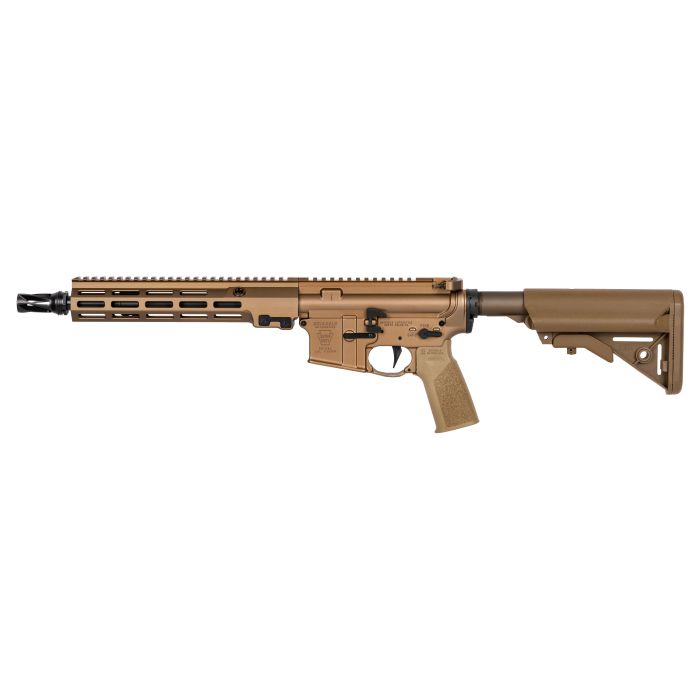
 If you walked into a gun store five years ago and wanted a rifle with an 11.5-inch barrel, you had two highly annoying options. You could pay the government $200 for a tax stamp, submit your fingerprints, and wait eight months for approval. Or, you could buy an “AR Pistol,” slap a flimsy plastic brace on the back, and pray the ATF didn’t change their mind about its legality next week. In today’s market, the best choice is often a factory SBR.
But as we survey the tactical landscape in February 2026, the game has fundamentally changed. Following the massive legislative shifts and the passing of the “One Big Beautiful Bill” that took effect on January 1st, the $200 NFA tax stamp for Short-Barreled Rifles (SBRs) and suppressors is officially dead.
As we dive deeper into this topic, it’s crucial to understand that a factory SBR offers improved handling and maneuverability compared to traditional rifles.
With the recent changes, the factory SBR stands out as a top option for enthusiasts looking for performance and compliance.
The modern “Winning Gun” is a true, factory SBR, setting new standards in versatility and performance.
1. The End of the “Pistol Brace” Era
For a decade, the AR pistol brace was the ultimate legal workaround. It allowed us to own short guns without the tax, but it came with massive compromises. The braces were flexible, they lacked proper cheek welds, and they were constantly under threat of federal reclassification.
In 2026, we don’t need workarounds. We use real stocks.
-
The Stability Factor: Dropping a true B5 Systems SOPMOD or a Magpul CTR stock onto an 11.5-inch carbine provides an absolute, rock-solid lockup against your shoulder.
-
Recoil Management: A rigid stock allows you to drive the gun harder and manage recoil vastly better than a rubber brace ever could, resulting in significantly faster split times during CQB drills.
2. The Ballistic Sweet Spots
The 16-inch barrel became the American standard not because it was tactically superior, but simply because the government said 15.9 inches was illegal without a stamp. Now that we can choose the optimal length for the cartridge, the market has standardized on two specific geometries.
-
The 11.5-inch 5.56 NATO: This is the undisputed 2026 CQB king. Unlike the 10.3-inch barrels that historically beat their parts to death, the 11.5-inch barrel provides 40% more “dwell time” (the time the bullet spends in the barrel after passing the gas port). This results in a smoother-shooting, infinitely more reliable rifle that still clears doorways effortlessly.
-
The 8.5-inch .300 Blackout: Because the .300 BLK cartridge burns all of its powder in just 9 inches of barrel, running it in a 16-inch gun is a complete waste of space. An 8.5-inch SBR gives you a backpack-sized PDW that hits with the kinetic energy of an AK-47.
3. The Suppressor Synergy
You cannot talk about the 2026 SBR boom without talking about suppressors (which are also now tax-free).
If you take a standard 16-inch rifle and thread a 6-inch suppressor onto the end, you have just created a 22-inch musket. It is front-heavy, miserable to swing inside a vehicle, and impossible to navigate through the tight hallways of a home.
-
The “Flush” Math: If you take an 11.5-inch SBR and attach a 5-inch flow-through suppressor (like the HUXWRX Flow 556k), the overall length of the weapon system is nearly identical to a bare 16-inch rifle.
-
The Result: You get a suppressed, flash-hidden, hearing-safe weapon system that handles exactly like a standard carbine. It is the ultimate home defense setup.
4. 2026 Leaderboard: The Factory SBR Heavyweights
With the tax barrier removed, major manufacturers are focusing their premium lines entirely on factory SBR configurations.
| Model | Barrel Length | 2026 “Winning” Advantage |
| Geissele Super Duty SBR | 11.5″ | Features the ultra-reliable mid-length gas system on an 11.5″ barrel, creating the smoothest shooting 5.56 on the market. |
| Daniel Defense MK18 | 10.3″ | The military-proven classic. Built like a tank with the legendary RIS II quad rail and a bomb-proof gas port. |
| Sig Sauer MCX Spear-LT | 11.5″ | The piston-driven king. Allows for a folding stock (because there is no buffer tube) while remaining incredibly lightweight. |
| B&T APC9 PRO | 6.9″ | The ultimate 9mm subgun. Swiss-machined perfection that fits inside a standard laptop bag. |
5. Maintenance/Logistics: Navigating the Wait
While the $200 financial penalty is gone, the ATF still processes the background checks and registration forms for SBRs.
-
The 2026 Surge: Because the tax was dropped, the ATF is currently processing a historic, massive wave of applications.
-
The Playbook: Buy your factory SBR now. Submit your electronic Form 4. The wait times might be fluctuating this year due to the sheer volume of buyers, but the days of paying a $200 toll just to put a stock on your rifle are over forever. Be patient, and reap the rewards of a proper weapon system.
Conclusion: Cut the Weight, Keep the Fight
The 16-inch barrel was a legal compromise, and the modern tactical shooter no longer has to compromise. The Factory SBR delivers everything you need for close-to-mid-range engagements—maneuverability, balance, and suppressor compatibility—without the massive footprint of a full-size rifle. It is the definitive standard for the 2026 loadout.
Ready to upgrade to a true Short-Barreled Rifle?
We are constantly tracking the best tactical sweepstakes across the web so you don’t have to. Head over to wintheguns.com to browse the latest aggregated giveaways and find your chance to win premium factory SBRs, suppressors, and elite tactical gear today.
Without the $200 tax stamp, and faster returns on the paperwork everyone is going for the items they have always wanted.
Never heard of the B&T 9mm – but the other 4 are some of my all time favorites
This is so true, but i will always prefer 11.5 inch with a great pistol brace that feels right incase i have to swing my weapon out either window making my setup so much lighter and versatile
Why would you not get a factory sbr. It’s easier than ever
Stamps are getting approved, FAST.
i am excited about the removal of $200 cost for NFA items
Glad the $200 fee is gone, now if we could just get rid of the extra paperwork too
If I could own a serious, this one would be a top choice.
About time! Now we need to get them declassified so you don’t have to jump through the paperwork hoop.
There are not much diffences in ballistics at 100 yards from 16 to 11.5
Over that, there actually is…but why would you need to use this platform over 100 yards anyway?
I am glad for the fee to be gone for most, but as a VA resident we are bracing for what our idiot governor is trying to force us to pay!
Thank you, Pres Trump!
Trump has nothing to do with this… He is no real friend of the 2A.
I think most people are still Form 1’ing their braced stuff right now. Give it a year.
Let’s go. I have a gun that needs to be SBR’d
No $200.00 tax stamps.
Just put together my first 10.3” mk18 sbr.. I’ll never look at a 16” again. If anything I’ll get an ar10 if I’m going for a longer barrel
Finally the $200 stamp is gone
Longer barrel more accuracy!!
Without the tax stamp, I may be in the market for an SBR and a suppressor.
Most people that I know are doing factory suppressors and Form 1’ing their braced pistols. Only a couple of people I know are buying factory SBRs, and they are not ARs. The person I know that does laser engraving is literally working 7 days a week doing SBR receivers for people and is considering buying a second machine and training his wife. I suspect that once the suppressor demand drops and folks Form 1 all their “I really wanted an SBR” guns, they will start looking at what SBRs are available ready to go.
I do like fde that’s sharp..
I am keeping some of my braced weapons. Don’t want them on a list.
It’s awesome they got rid of the fee, wish the paperwork was gone too.
With the tax stamp out of the way it will be a game changer in opinions for me. Now is the time to end registration BS ??
The tax stamp has been in affect way to long! Should not have to go through a bunch of paper work to!
Stamp out of the way is a game changer
Glad that tax was repealed
The $0 stamp was a small step in the right direction.
Now we just need to put the NFA in the grave completely
Imagine the boundless freedom once the NFA and ATF is stripped bare
If you aren’t needing to use an LRP or target rifle, an AR pistol or SBR is often the way to go. No stamp helps make that possible.
I’m hoping that a SBR is in my future, really near future.
It’s simple, the barrel length shouldn’t be a concern for the government
KEEP the SBR Un-burned powder blasts!
I have an AR-15 pistol with a blade brace. Looks like it’s time to SBR it.
Defund the ATF. Fact is, the A (Alcohol) and T (Tobacco) parts do basically nothing. It is the unconstituional F part that exists to take away a persons F
Tax stamp removal really made suppressors an option for me.
I would rather a 16″ or 18″ myself as I do mostly long range shooting.
Good things come to he that waits. Now do the paperwork next.
Glad the $200 fee is gone.
Aside from the process being the same that $200 savings is pretty nice for getting ammo
Happy the fee is gone
Illinois has the pistol brace ban; which i dont get a lot of their restrictions. Its just one more thing to have control over. Hopefully better laws will come down the pike.
The ATF should learn to play by its own rules.
Glad the $200 fee is gone so I can buy more ammo!
Time to get rid of both the NFA and the ATF
Sign me up for that