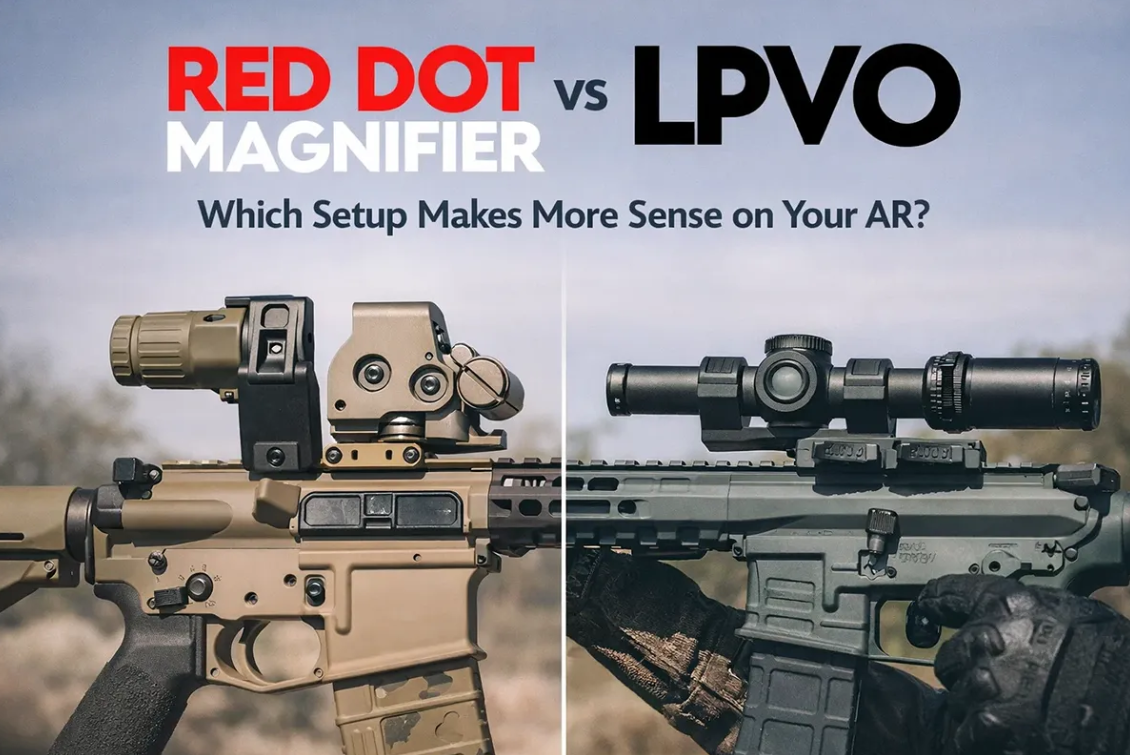
 If you built a general-purpose AR-15 five years ago, the internet gave you exactly one acceptable answer for aiming: buy a Low Power Variable Optic (LPVO). We strapped heavy 1-6x scopes to our rifles, convinced that we needed sniper-level magnification to shoot paper targets at 50 yards.
As we analyze the trends dominating the wintheguns.com community in March 2026, that universal consensus has violently fractured.
The modern “Winning Gun” is caught in the middle of a massive tactical debate. On one side, the proven versatility of the 1-6x LPVO. On the other, the resurgence of the ultra-fast red dot and magnifier combo. Both systems claim to be the ultimate do-it-all solution. Here is exactly why your current setup might be slowing you down, and how to choose the best AR-15 optic 2026 has to offer for your specific mission.
1. The Physics of the Eye Box and the 1x Illusion
The biggest selling point of an LPVO is that it supposedly acts just like a red dot when dialed down to 1x magnification.
-
The LPVO Reality: A scope is bound by the physics of lenses. To see through an LPVO clearly, your eye must be perfectly aligned behind the glass at a very specific distance (the eye relief). If you are shooting from an awkward barricade or wearing a gas mask, the scope shadow will completely black out your vision. It is never as fast as a true red dot.
-
The Red Dot Advantage: A red dot or holographic sight has infinite eye relief. As long as you can physically see the glass, you can see the dot. You can shoot from under a vehicle or perfectly pie a corner without needing a pristine cheek weld. For pure Close Quarters Battle (CQB), the red dot remains the undisputed king of speed.
2. The Astigmatism Factor: The Red Dot Killer
If the red dot is vastly faster, why doesn’t everyone just run a combo? The answer lies in the human eye.
Millions of shooters suffer from astigmatism—an imperfection in the curvature of the eye’s cornea.
-
The Red Dot Starburst: If you have an astigmatism, a traditional LED red dot does not look like a perfectly crisp circle. It looks like a distorted, smeared starburst or a cluster of grapes. When you put a 3x magnifier behind a smeared dot, the magnification amplifies the distortion, covering your entire target at 100 yards and making precision accuracy impossible.
-
The LPVO Fix: An LPVO uses a physical reticle etched directly into the glass. Even if you have terrible astigmatism, an etched reticle remains surgically crisp and razor-sharp. For shooters with bad eyes, an LPVO isn’t just a preference; it is a mechanical necessity.
3. 2026 Leaderboard: The Best Tactical Optic Kings
Choosing the Best AR-15 Optic 2026 for Your Needs
Whether you prioritize the surgical precision of glass or the raw speed of a glowing dot, the 2026 market has perfected both platforms.
| Brand & Model | Setup Type | 2026 “Winning” Advantage |
| Vortex Razor HD Gen II-E (1-6x) | LPVO | The gold standard. Delivers a famously massive eye box, incredible glass clarity, and a center dot that is authentically “red dot bright” under the midday sun. |
| EOTech EXPS3 & G33 | Holographic + Magnifier | The combat-proven heavy hitter. Because it uses a laser hologram instead of an LED, the 1-MOA center dot remains perfectly tiny even when magnified to 3x. |
| Primary Arms PLx Compact (1-8x) | LPVO | The modern disruptor. Shrinks 8x magnification down to the physical footprint of an old-school red dot, drastically cutting the historical weight penalty of LPVOs. |
| Cyelee Optics Ghost & 3x Magnifier | Red Dot + Magnifier | The ultimate budget-friendly durability. Brings duty-grade enclosed emitters and crystal-clear magnification to the working-class defender without the premium price tag. |
4. The Weight and Balance Penalty
Rifles are heavily subjected to the laws of leverage. Where you place weight matters just as much as how much weight you add.
-
The LPVO Anchor: A quality LPVO and a heavy-duty scope mount will easily add 25 to 30 ounces to the top of your receiver. Because it is a single, heavy tube, you cannot change this weight. If you are clearing rooms for hours, that top-heavy leverage will exhaust your arms.
-
The Combo Modularity: A red dot and magnifier combo typically weighs slightly less, but its true advantage is modularity. Most modern magnifiers are mounted on Quick Detach (QD) throw levers. If you know you are fighting purely indoors today, you can rip the heavy magnifier off the gun entirely, instantly shedding half a pound and transforming the rifle into an ultra-light CQB tool.
5. Maintenance: The Battery Death Trap
Electronics fail. If you run your rifle hard enough, in cold enough temperatures, your battery will eventually die in the middle of a string of fire.
-
The Combo Weakness: If the battery dies in your red dot or holographic sight, your optic is a dead, empty window. You cannot aim. You must transition to heavy, cumbersome backup iron sights to stay in the fight.
-
The LPVO Failsafe: An LPVO does not require a battery to function. The battery simply illuminates the etched reticle for faster contrast against dark backgrounds. If the battery dies, you still have a perfectly functional, pitch-black crosshair permanently etched into the glass. It is a completely self-sustaining aiming system.
Conclusion: Define Your Fight
There is no universal winner in the LPVO vs red dot magnifier debate. You have to define your most likely environment. If your property demands taking precise shots past 200 yards, identifying targets through brush, or managing astigmatism, the LPVO is your definitive answer. But if your primary concern is defending the inside of your home or navigating tight urban structures with maximum speed, the red dot and magnifier combo remains undefeated.
Ready to upgrade your aiming solution?
We are constantly tracking the best tactical sweepstakes across the web so you don’t have to. Head over to wintheguns.com to browse the latest aggregated giveaways hosted by our industry partners.
It comes down to what works best for you, in your application or circumstance. I love my EOTech red dot/magnifier but with my dry eyes and slight astigmatism the 1-moa becomes a 5-moa then add the magnifier to just make a large “smear” covering the target. Even with that it still reigns supreme in CQ target acquisition.
When I have time to take the shot I much prefer the LPVO for pin-point targeting.
Bottom line – “it all depends…”
-Ron
Depends on the particular weapon build and use. I prefer red dot and magnifier for home protection, but an LPVO, or other type of scope, for target shooting.
Both options have their pros and cons. Personally, I prefer the LPVO. It’s the all in one option. It all comes down to preference.
I can get by with the Red Dot + Magnifier
It’s hard to say what’s better, if you have a 16” I’d say a LPVO but if you have a sbr I’d rock a eotech and 3x or a red dot alone
“We strapped heavy 1-6x scopes to our rifles, convinced that we needed sniper-level magnification to shoot paper targets at 50 yard”
I feel attacked….At least I got a scope with really good eye relief haha
I have astigmatism and with prescription safety glasses the EOTech seems totally fine with and without magnification for me. I have very tight groupings out to 50 yards.
One of my next rifles will be for long range and I’m planning on a long range tactical scope for it.
Give me the Vortex Razor HD Gen II-E (1-6x)!!
Loadout and mission ….
What when where how long, how many
All contribute to decisions
So yea, it depends
I agree with HDFYREGUY, it all depends on loadout, mission, and (mostly) preference.
I’d say it all comes down to preference
There’s always something new to try.
i don’t like magnifiers
They have their place.
the PLXcs are awesome.
It is a matter of preference in my opinion. I find both useful in different scenarios, so I use them both.
Currently have red dots and love them, but wouldn’t mind trying an LPVO sometime just to see.
This is something I’ve been debating for a while
I hate my astigmatism
LPVO for the win…. even the budget ones like Monstrum and Vector/Victor Optics work for me.
Not having much experience with either, I have little to say or debate. But what I can say is this article was both very fascinating and informative!
Currently all I use are red dots never tried a magnifier.
Both are great
This is a
This is a very informative article, thank you for sharing
Vortex rules!!
I really prefer LPVO for general purpose with a mini rds either canted or piggyback on top of your LPVO.
I like LPVO better for hunting than dots.
Really nice
LPVO guy myself…but 600 yards is still game for me
great comparison
I like LPVOs for versatility, but a red dot with magnifier is hard to beat for speed and simplicity.
Just get yourself some top quality mounts that can be swapped depending on your use case. As long as your mounts are good enough not to lose zero then you are set. If mixed conditions just run your red dot at a 45 degree angle and your LPVO on top of the gun.
I have one in both eyes, but love my red dots.
Depends on the gun and the shooter. There’s rarely a “one size fits all”.